Category Archives: Awards

Call for Nominations: 2013 PET Award

I am on the award committee for the 2013 PET Award and we are looking for nominations of papers which have made an outstanding contribution to the theory, design, implementation, or deployment of privacy enhancing technology.

The 2013 award will be presented at Privacy Enhancing Technologies Symposium (PETS) and carries a prize of $3,000 USD thanks to the generous support of Microsoft. The crystal prize itself is offered by the Office of the Information and Privacy Commissioner of Ontario, Canada.

Any paper by any author written in the area of privacy enhancing technologies is eligible for nomination. However, the paper must have appeared in a refereed journal, conference, or workshop with proceedings published in the period from 16 April 2011 until 31 March 2013.

To submit a nomination, please see the instructions on the award page.

Call for nominations for PET Award 2012

Nominations are invited for the 2012 PET Award by 31 March 2012.

The PET Award is presented annually to researchers who have made an outstanding contribution to the theory, design, implementation, or deployment of privacy enhancing technology. It is awarded at the annual Privacy Enhancing Technologies Symposium (PETS).

The PET Award carries a prize of 3000 USD thanks to the generous support of Microsoft. The crystal prize itself is offered by the Office of the Information and Privacy Commissioner of Ontario, Canada.

Any paper by any author written in the area of privacy enhancing technologies is eligible for nomination. However, the paper must have appeared in a refereed journal, conference, or workshop with proceedings published in the period from 1 June 2010 until 31 March 2012.

For eligibility requirements, refer to the award rules.

Anyone can nominate a paper by sending an email message containing the following to award-chairs12@petsymposium.org:

  • Paper title
  • Author(s)
  • Author(s) contact information
  • Publication venue and full reference
  • Link to an available online version of the paper
  • A nomination statement of no more than 500 words.

All nominations must be submitted by 31 March 2012. The Award Committee will select one or two winners among the nominations received. Winners must be present at the 2012 PET Symposium in order to receive the Award. This requirement can be waived only at the discretion of the PET Advisory board.

More information about the PET award (including past winners) is see the award website.

The PET Award: Nominations wanted for prestigious privacy award

The PET Award is presented annually to researchers who have made an outstanding contribution to the theory, design, implementation, or deployment of privacy enhancing technology. It is awarded at the annual Privacy Enhancing Technologies Symposium (PETS).

The PET Award carries a prize of 3000 USD thanks to the generous support of Microsoft. The crystal prize itself is offered by the Office of the Information and Privacy Commissioner of Ontario, Canada.

Any paper by any author written in the area of privacy enhancing technologies is eligible for nomination. However, the paper must have appeared in a refereed journal, conference, or workshop with proceedings published in the period from August 8, 2009 until April 15, 2011.

The complete award rules including eligibility requirements can be found under the award rules section of the PET Symposium website.

Anyone can nominate a paper by sending an email message containing the following to award-chair11@petsymposium.org.

  • Paper title
  • Author(s)
  • Author(s) contact information
  • Publication venue and full reference
  • Link to an available online version of the paper
  • A nomination statement of no more than 500 words.

All nominations must be submitted by April 15th, 2011. The Award Committee will select one or two winners among the nominations received. Winners must be present at the PET Symposium in order to receive the Award. This requirement can be waived only at the discretion of the PET Advisory board.

More information about the PET award (including past winners) is available at http://petsymposium.org/award/

More information about the 2011 PET Symposium is available at http://petsymposium.org/2011.

Capsicum: practical capabilities for UNIX

Today, Jonathan Anderson, Ben Laurie, Kris Kennaway, and I presented Capsicum: practical capabilities for UNIX at the 19th USENIX Security Symposium in Washington, DC; the slides can be found on the Capsicum web site. We argue that capability design principles fill a gap left by discretionary access control (DAC) and mandatory access control (MAC) in operating systems when supporting security-critical and security-aware applications.

Capsicum responds to the trend of application compartmentalisation (sometimes called privilege separation) by providing strong and well-defined isolation primitives, and by facilitating rights delegation driven by the application (and eventually, user). These facilities prove invaluable, not just for traditional security-critical programs such as tcpdump and OpenSSH, but also complex security-aware applications that map distributed security policies into local primitives, such as Google’s Chromium web browser, which implement the same-origin policy when sandboxing JavaScript execution.

Capsicum extends POSIX with a new capability mode for processes, and capability file descriptor type, as well as supporting primitives such as process descriptors. Capability mode denies access to global operating system namespaces, such as the file system and IPC namespaces: only delegated rights (typically via file descriptors or more refined capabilities) are available to sandboxes. We prototyped Capsicum on FreeBSD 9.x, and have extended a variety of applications, including Google’s Chromium web browser, to use Capsicum for sandboxing. Our paper discusses design trade-offs, both in Capsicum and in applications, as well as a performance analysis. Capsicum is available under a BSD license.

Capsicum is collaborative research between the University of Cambridge and Google, and has been sponsored by Google, and will be a foundation for future work on application security, sandboxing, and security usability at Cambridge and Google. Capsicum has also been backported to FreeBSD 8.x, and Heradon Douglas at Google has an in-progress port to Linux.

We’re also pleased to report the Capsicum paper won Best Student Paper award at the conference!

IEEE best paper award

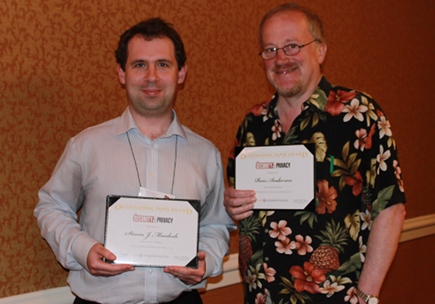
Steven Murdoch, Saar Drimer, Mike Bond and I have just won the IEEE Security and Privacy Symposium’s Best Practical Paper award for our paper Chip and PIN is Broken. This was an unexpected pleasure, given the very strong competition this year (especially from this paper). We won this award once before, in 2008, for a paper on a similar topic.

Ross, Mike, Saar, Steven (photo by Joseph Bonneau)

Update (2010-05-28): The photo now includes the full team (original version)

PET Award 2008

At last year’s Privacy Enhancing Technologies Symposium (PETS), I presented the paper “Sampled Traffic Analysis by Internet-Exchange-Level Adversaries”, co-authored with Piotr Zieliński. In it, we discussed the risk of traffic-analysis at Internet exchanges (IXes). We then showed that given even a small fraction of the data passing through an IX it was still possible to track a substantial proportion of anonymous communications. Our results are summarized in a previous blog post and full details are in the paper.

Our paper has now been announced as a runner-up for the Privacy Enhancing Technologies Award. The prize is presented annually, for research which makes an outstanding contribution to the field. Microsoft, the sponsor of the award, have further details and summaries of the papers in their press release.

Congratulations to the winners, Arvind Narayanan and Vitaly Shmatikov, for “Robust De-Anonymization of Large Sparse Datasets”; and the other runner-ups, Mira Belenkiy, Melissa Chase, C. Chris Erway, John Jannotti, Alptekin Küpçü, Anna Lysyanskaya and Erich Rachlin, for “Making P2P Accountable without Losing Privacy”.

"Covert channel vulnerabilities in anonymity systems" wins best thesis award

My PhD thesis “Covert channel vulnerabilities in anonymity systems” has been awarded this year’s best thesis prize by the ERCIM security and trust management working group. The announcement can be found on the working group homepage and I’ve been invited to give a talk at their upcoming workshop, STM 08, Trondheim, Norway, 16–17 June 2008.

Update 2007-07-07: ERCIM have also published a press release.

PED vulnerability paper receives "Most Practical Paper" award at Oakland

In February, Steven Murdoch, Ross Anderson and I reported our findings on system-level failures of widely deployed PIN Entry Devices (PED) and the Chip and PIN scheme as a whole. Steven is in Oakland presenting the work described in our paper at the IEEE Symposium on Security and Privacy (slides).

We are very pleased that we are the recipients of the new “Most Practical Paper” award of the conference, given to “the paper most likely to immediately improve the security of current environments and systems”. Thanks to everyone who supported this work!

IEEE Security & Privacy Magazine Award

Award Winners #2

Two years ago, almost exactly, I wrote:

Congratulations to Steven J. Murdoch and George Danezis who were recently awarded the Computer Laboratory Lab Ring (the local alumni association) award for the “most notable publication” (that’s notable as in jolly good) for the past year, written by anyone in the whole lab.

Well this year, it’s the turn of Tyler Moore and myself to win, for our APWG paper: Examining the Impact of Website Take-down on Phishing.

The obligatory posed photo, showing that we both own ties (!), is courtesy of the Science Editor of the Economist.

Tyler Moore and Richard Clayton, most notable publication 2008